

In modern conflicts, military camouflage plays a crucial role in ensuring the safety and success of operations on the ground. It is a method of concealment used by armed forces to deceive the enemy and reduce their ability to detect and target troops, vehicles, or installations/>
Choosing the camouflage pattern according to the environment
There are several types of camouflage patterns that can be used depending on the environment in which the troops are located. The choice of pattern generally depends on the geographical and climatic characteristics of the operational area:
- Forest camouflage: this involves colors and patterns representing foliage, branches, and trees to blend as well as possible into a forest or dense vegetative environment.
- Desert camouflage: this type of camouflage mainly uses shades of brown, beige, and ochre to mimic the arid and sandy landscapes of the desert.
- Urban camouflage: it is designed to provide visual protection in an urban context with buildings, artificial structures, and industrial elements. Urban camouflage patterns are generally composed of geometric shapes and neutral colors.
- Snow camouflage: it is characterized by the use of white and gray colors to blend into snowy or icy landscapes.
Materials and methods used for military camouflage
To meet the specific needs of soldiers, creators of military camouflage solutions have developed different types of materials and techniques that allow for an optimal concealment effect. Among them:
Camouflage netting
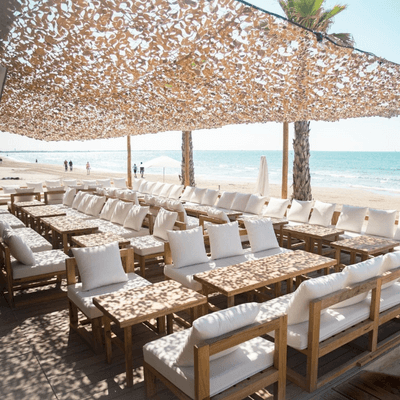
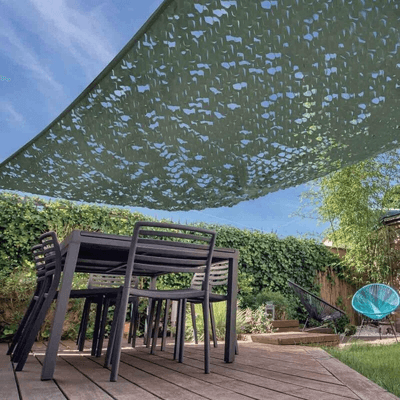
This is a versatile and lightweight tool used to cover various elements on the ground, such as vehicles, tents, or firing positions. They can also be used to create screens that block multispectral signatures (thermal, infrared), helping to reduce detection by friendly forces. The camouflage netting can be made from different materials such as fabric or plastic, and offers a variety of patterns suited to each environment.
Camouflage paint
Used mainly on vehicles and certain tactical equipment, camouflage paint provides a durable way to alter the appearance of surfaces according to the operational context. There are ranges of water-releasable products that facilitate touch-ups directly on the equipment to be protected.
Camouflage fabric
All military uniforms are designed to offer maximum protection and concealment to soldiers. Camouflaged clothing thus uses specific fabrics that combine comfort, durability, and discretion in various environments. To achieve this, digital printing on fabric is often used to faithfully reproduce the selected camouflage patterns.
Modern technologies serving military camouflage
With technological advances, the field of military camouflage is undergoing a true revolution. In this regard, several innovative solutions have been developed to improve the performance of concealment systems:
Multispectral camouflage
Multispectral camouflage is a cutting-edge technique that combines several concealment spectra into a single printed motif on the protected equipment, making troops and gear nearly undetectable by the enemy. This type of camouflage covers the visible, infrared, thermal, and radar domains.
Adaptive clothing
Some defense companies are currently working on prototypes of clothing and equipment capable of autonomous environmental reflections to adapt almost in real time to the color and pattern of their surroundings. By combining photochromic or electrochromic sensor fibers, these systems promise unprecedented visual blending capabilities.
Personal camouflage tools
There are also individual camouflage accessories for soldiers. Among them, camouflage ear warmers for winter operations, thermal headbands, and of course the timeless face mask which has been worn by armies worldwide for several decades.
Implementing an effective camouflage strategy
Whether it is to protect a military camp, conceal a tactical vehicle, or make the position of a hidden marksman less visible, it is crucial to implement a comprehensive and thoughtful approach to maximize the effectiveness of camouflage:
- Be creative: Using natural materials available on site can help strengthen the visual illusion. For example, laying a bed of dead leaves under a camouflage net in the forest, or gathering seaweed around a firing position on the beach.
- Consider all senses: Incorporate the sound dimension into your camouflage setup if needed: covering the hum of engines with ambient music through hidden speakers or creating auditory decoys are valuable opportunities in risky situations
- Convey the idea of "invisibility": integrate this notion into working methods as well as the principles followed by everyone, including the use of non-standard camouflage devices, such as mud stamping on surfaces that reflect a lot of light>

Leave a comment
All comments are moderated before being published.
This site is protected by hCaptcha and the hCaptcha Privacy Policy and Terms of Service apply.