
The terrace is a very popular space for relaxation and socializing when the good weather arrives. To fully enjoy it, it is essential to choose a covering solution adapted to your needs and budget. In this article, discover the different ways to cover a terrace without a terrace shelter, their advantages and disadvantages, as well as our advice to make the best choice depending on your roof.
Different ideas to cover outdoor terraces cheaply against the sun
There are several solutions to protect your terrace from the sun without ground impact and with great ease, from rain or prying eyes. Here are the main ones:
- The shade sail
- Reed screens
- Pergolas and gazebos
- Conservatories and glass roofs
The shade sail: a practical and aesthetic solution for a self-sheltered terrace
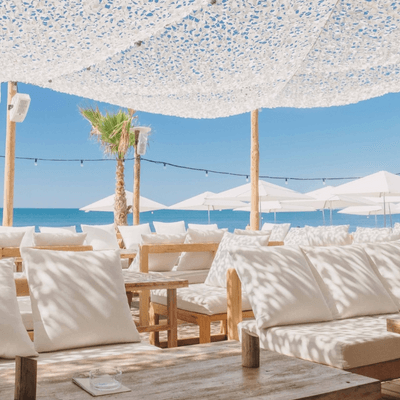
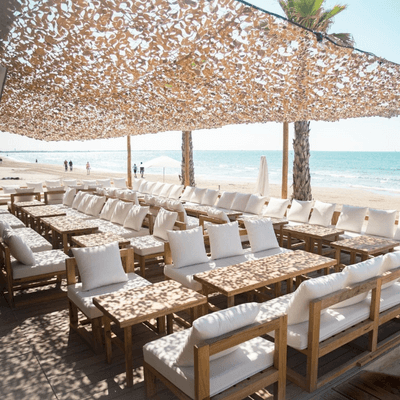
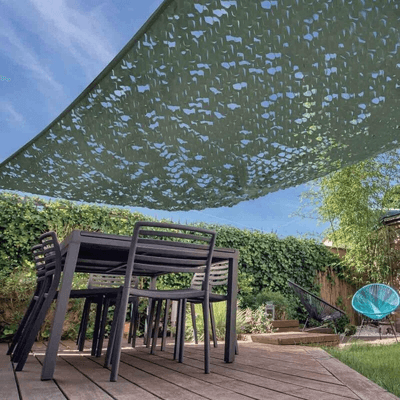
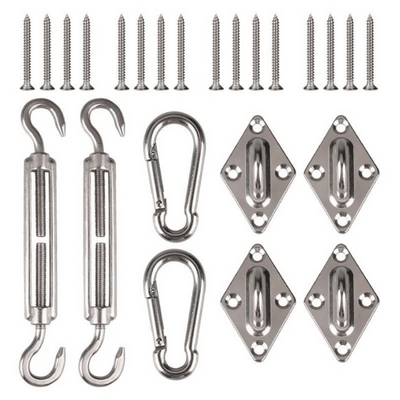
The camouflage shade sail is a lightweight and durable fabric stretched between several anchor points to create a shaded area on the terrace. Available in different shapes (square, rectangular, triangular) and colors, it easily adapts to all terrace styles, attached either at the roof level or on a pergola. It will protect your terrace from the sun with great ease and at a low cost, without any huge project! Perfect for nature lovers, the camouflage net will help create a contemporary atmosphere and good heat insulation easily. This will increase the available space in summer by providing a high level of comfort thanks to our stretched fabric. You will gain living space in the height of summer even during heat waves and without a terrace shelter.
The advantages of the shade sail are numerous:
- Ease and speed of installation
- Aesthetics and modernity
- Good protection against the sun's UV rays
- Affordable price
However, this solution also has some drawbacks:
- Low resistance to weather (strong wind, rain)
- Requires sturdy anchor points
Reed mats: a natural and economical alternative for a covered wooden terrace
Reed mats are panels made of plant slats (reed, bamboo, willow) or plastic, which are fixed onto a wooden or metal structure to cover the terrace. They offer effective protection against the sun while creating an intimate and warm space.
The advantages of reed mats are:
- Their natural and ecological aspect (for plant-based reed mats)
- Their low cost
- Their ease of installation and maintenance
However, they also have disadvantages:
- Average resistance to bad weather
- Limited protection against rain
- Durability varies depending on the chosen material
Pergolas and arbors: versatile and durable polycarbonate structures
Pergolas and arbors are wooden or metal structures, fixed or removable, which can be covered with different materials (fabric, reed mats, polycarbonate) to create a shaded area on the terrace. They can also be adorned with climbing plants for a green touch on the green roof.
Their main advantages are:
- Their high resistance to bad weather
- Their durability
- Their modularity: they can be adapted to all sizes and configurations of terraces
- Their aesthetics: they add value to the outdoor layout
On the other hand, they have some disadvantages:
- Their higher cost compared to other solutions
- Longer installation and maintenance time
Conservatories and glass roofs: a full-fledged extension of the house
Conservatories and glass roofs are constructions made of wood, aluminum, or steel, glazed on part or all of their walls, which allow covering the terrace while benefiting from natural light. They offer optimal protection against weather hazards and can be used as an additional living space.
Their advantages are:
- Their excellent level of protection and insulation
- Their aesthetics and brightness
- The possibility to enjoy the terrace all year round
- The enhancement of the property value
Nevertheless, they have some drawbacks:
- Their high cost (purchase and installation)
- Administrative procedures (building permits) sometimes required
- Regular maintenance of glazing and structures
How to choose the best solution to cover your terrace without authorization against rain: the shade sail?
To choose the right covering for your terrace, consider the following criteria:
- Your budget allocated to the project: some solutions are more affordable than others.
- Your protection needs: some devices offer better resistance to weather or better thermal insulation.
- Desired aesthetics: each type of covering has a different style that should match the layout of your terrace and the architecture of your house.
- Ease of installation and maintenance: some options are simpler to set up and maintain than others.
Don't hesitate to ask for the opinion of professionals or to consult testimonials from other users to help you make your choice. A retractable awning, a veranda, or a wooden pergola structure can also be viable solutions. Protecting your terrace from sun and rain should be a priority for homeowners. A very easy project would be to install a camouflage net over the terrace, which then withstands strong gusts as well as weather hazards. Very practical for shading an outdoor kitchen with a simple independent mast, it does not require prior work declaration and very few materials for a natural style.
In summary: How to cover your outdoor terrace at a low cost?
Each terrace covering solution has its advantages and disadvantages in terms of protection, aesthetics, cost, and ease of installation. To choose the one that suits you best, assess your needs, desires, and budget. And above all, take the time to compare the different options and seek advice from experts if necessary.

Leave a comment
All comments are moderated before being published.
This site is protected by hCaptcha and the hCaptcha Privacy Policy and Terms of Service apply.